Barometric pressure in Leeds
Air pressure rose slowly over the last 24 hours. It is 2 hPa higher than this time yesterday. The rise has run its course: it falls from here for the rest of the week.
Sea level reading, as of 16:00 local time.
The past week and the days ahead
The shaded part shows the days already gone. The thicker line is the forecast.
The week ahead
Each day at a glance: how far pressure moves, and the low and high it reaches.
Barely moves all day.
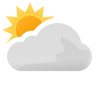 20° / 8°
low 1025 · high 1026 hPa
Falls steadily through the day.
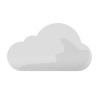 19° / 10°
low 1019 · high 1026 hPa
Falls steadily through the day.
21° / 13°low 1014 · high 1019 hPa
Eases down slowly through the day.
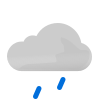 23° / 16°6.9 mm
low 1010 · high 1013 hPa
Falls steadily through the day.
19° / 16°9.0 mmlow 1004 · high 1011 hPa
Falls steadily through the day.
21° / 15°1.4 mmlow 999 · high 1003 hPa
Rises steadily through the day.
17° / 15°1.9 mmlow 998 · high 1005 hPa
Hour by hour
| Hour | Weather and temperature | Rain (mm) | Pressure (hPa) |
|---|---|---|---|
| 00:00 |  11° 11° | 1026 | |
| 01:00 | 10° | 1026 | |
| 02:00 | 10° | 1026 | |
| 03:00 | 9° | 1026 | |
| 04:00 | 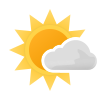 9° 9° | 1026 | |
| 05:00 | 9° | 1026 | |
| 06:00 | 8° | 1026 | |
| 07:00 | 9° | 1026 | |
| 08:00 | 11° | 1026 | |
| 09:00 | 13° | 1026 | |
| 10:00 | 15° | 1026 | |
| 11:00 | 17° | 1026 | |
| 12:00 | 18° | 1026 | |
| 13:00 | 18° | 1026 | |
| 14:00 | 19° | 1026 | |
| 15:00 | 20° | 1025 | |
| 16:00 | 20° | 1025 | |
| 17:00 | 20° | 1025 | |
| 18:00 | 19° | 1025 | |
| 19:00 | 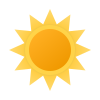 19° 19° | 1025 | |
| 20:00 | 17° | 1025 | |
| 21:00 | 16° | 1025 | |
| 22:00 | 14° | 1026 | |
| 23:00 | 13° | 1026 |
Biggest change: Thursday, down 8 hPa.
No turn is in sight: pressure falls for as far ahead as the forecast goes.
Leeds sits 49 m above sea level, so a barometer in the city reads about 6 hPa lower than the sea-level figure. A home station set to the local reading should show about 1019 hPa as of 16:00.
The hours already past are the model's record of each hour as it passed, anchored to real observations, though not a reading from an instrument in Leeds.
About Leeds
In Leeds the barometer's year peaks in spring. April readings average about 1017 hPa, the highest of any month, before the long slide to a November low near 1010. The daily weather is another matter. It delivers roughly 81 sharp changes a year, with late autumn and the turn of the year the busiest periods. The daily average sits below 1000 hPa on about 46 days a year. That is ordinary life here, not an event. In the eastern foothills of the Pennines, more than five settled days in a row is uncommon in any season.
Sources: WikipediaERA5 reanalysisElevation: Copernicus DEM via Open-Meteo
Cities nearby
Open one to see its pressure, or search for your own city at the top of the page.
Watching the sun as well? See how strong the UV is in Leeds right now, on our sister site  uvi.today.
Common questions
What is a normal barometric pressure?
Near 1013 hPa at sea level; the exact standard figure, 1013.25 hPa, is the same as 760 mmHg, 29.92 inHg or 101.3 kPa. Anything between roughly 1000 and 1025 hPa is ordinary. Which way it is going matters far more than the number itself.
Why does my own barometer show a different number?
Usually altitude, and sometimes the instrument itself. Weather services correct readings to what they would be at sea level, so that cities can be compared. The figure for Leeds, which stands 49 m above sea level, is in the note above: about 6 hPa below the sea-level reading. If your barometer is already set to sea level and still reads slightly differently, that is the setting on the instrument rather than the weather.
Is a millibar the same as a hectopascal?
Yes. One millibar and one hectopascal are exactly the same amount of pressure, so 1013 mbar and 1013 hPa mean the same thing. The name changed; the number did not.
Does falling pressure mean rain?
Not by itself. Away from the tropics, falling pressure usually means a low is approaching, and lows carry the fronts that bring cloud and rain, so the two often arrive together. But a shallow fall can pass with nothing more than cloud, and rain falls under steady pressure too. The graph tells you a system is on the way, not how wet it will be. The week ahead, just above, shows the rain forecast beside the pressure.
